
Are you a farmer at crunch point for deciding whether to proceed without urea or not, in the face of El Niño?
You might have more choices than you realise.
Let’s lay some out.
Disclaimer: we’re not agronomists and we don’t know your property, do your own research. These are just some ideas.
Is it worth doing anything without urea?
We are taught that urea (or other N fertilisers) is essential for producing a harvest.
This is not true.
Except for when it is: when we grow monocultures, when we treat the ground only as a growing medium, when we coat our seed in pesticides and use synthetic fertilisers to get them started. When the seed is a variety that expects that treatment and its core microbiome is degraded.
A recap of some biologically-mediated nitrogen key points:
All plants can get their own N when they are contributing members of a functional soil ecology.
The air is 78% N. It is fixed by lightning and microbes then cycled through water, soil, plants and other life forms.
Plants that feed soil microbes their sugars reap the bounty. Plants that are neighbours of plants that feed soil microbes their sugars also reap the bounty. Plants like it when they have diverse neighbours. It works for everyone.
Free-living N-fixing microbes are just as important as the symbiotic ones in legumes, but all plants can access their N.
Plants that live in a microbially healthy soil can increase their N uptake by 30% through the ‘rhizophagy cycle’.
Plants in a diverse community of 16+ plant families have comparable or higher rates of production to those that use N fertilisers according to the Jena Experiment.
Earthworms (which feed on microbes and line their tunnels with bioavailable N) mitigate nutrient deficencies in soils and increase production.
How do I get enough Nitrogen from biology?
Sowing your seed without urea on hand means you need to support soil N-cycling processes.
Critically, this means adding in plant species from other families. They could be only a small fraction of what you put in. They can be in interrows or as sub-canopy cover. They could be a complimentary cash crop, they could be targeted at soil improvement. Check out our recent post ‘An easy way to start with multi species’ as an example!
It also means establishing your seed strongly.
Use a bioprimer on your bare seed to connect it to the soil N supply immediately.
Biocast is ideal for this purpose. Apply from 5 L/tonne seed, either at seeding or apply then dry for later sowing.
The beauty of taking these actions is that they are highly likely (based on multiple scientific studies of both multi species farming, and of earthworms and their byproducts, including liquid vermicasts) to also give your land and plants significant resilience to El Niño conditions.
What to expect:
Your germinating seed will grow down first. It will be feeding soil microbes and establishing deep roots before it shoots up:
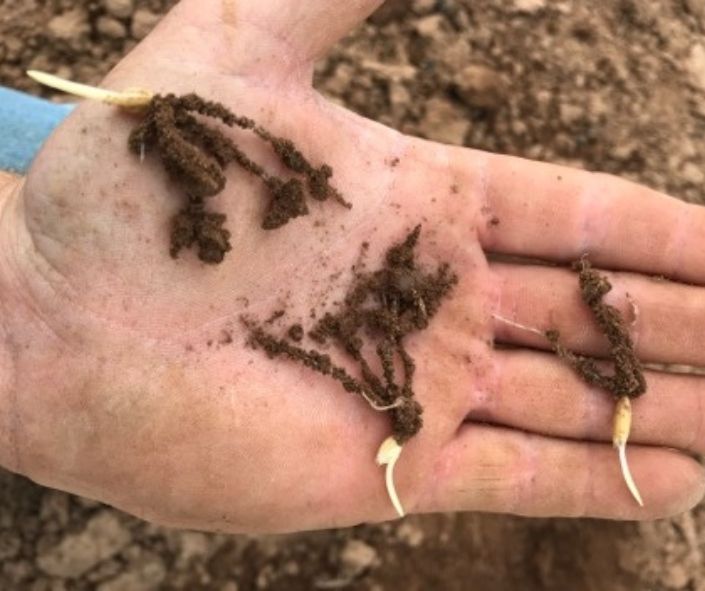
Above: typical results Biocast users see with bioprimed seed, noting advanced root development relative to shoots, and the strong rhizosphere development.
In a dry season, above ground biomass might be less than you’re used to, especially in the first year. You have handed the reigns to the plant to grow according to the season and other environmental factors. You will likely see a burst of growth after rain.
Addressing calcium deficiencies early will help a lot.
Your plant will likely benefit from targeted foliar nutrition around the 3 month mark. In year 1 & 2 you will probably need to feed gently with protein hydrolysate or a reduced amount of urea + carbon if your goal is a decent harvest. Monitor the plant and seek agronomic advice.
The end of the season will be the tell. You will likely fare better than your neighbours.
Yield will be unpredictable in year 1. It could be below average. So much depends on your starting point. Yield should increase in years 2-3 with soil-friendly management.
There is a learning curve.
Other likely benefits
We have witnessed these benefits, or they are documented in scientific literature:
- Harvest will likely be higher quality
- Less susceptible to pests and diseases
- More resilience to climatic extremes
- Soil improvements such as better water retention properties, better texture
- You don’t have to kill anything to get started
- You don’t need any starter ferts
- Save money on bare seed
- Animal health improvements
- Plants don’t pull out so easily, get an extra graze
- What comes next in that field also benefits
- Don’t underestimate the human wellbeing factor of having something growing in spite of everything
The thing about handing your crop to biology is that it can feel like handing over control, especially when you’re used to the predictable responses to urea. It can take time to build the trust – and to wean your plants off urea!
Are you ready to partner with your land, and reap the rewards?
Start small if you need. You have options.
What could this look like for you?
Could it look like having a crack where you weren’t going to? Or seeing what happens in one paddock? Perhaps using a green fallow to improve the soil for next season? Or seeing if you can grow hay, silage, or even mulch for your own use instead?
It could be possible that putting an emphasis on soil function this season will create opportunities for your farming enterprise.
Please get in touch if you would like to talk anything through.
P.S. I’d love to add some studies in here for you, but for now it will have to wait. Please comment below if there’s something we mentioned here that you’d really like a link to.